
Application / Commercial & Residential Safety
Household & Commercial Gas Alarm Sensor Selection
Sensor selection for alarm and appliance makers: household gas and CO alarms, ventilation and commercial kitchens, where long-term stability with minimal maintenance wins.
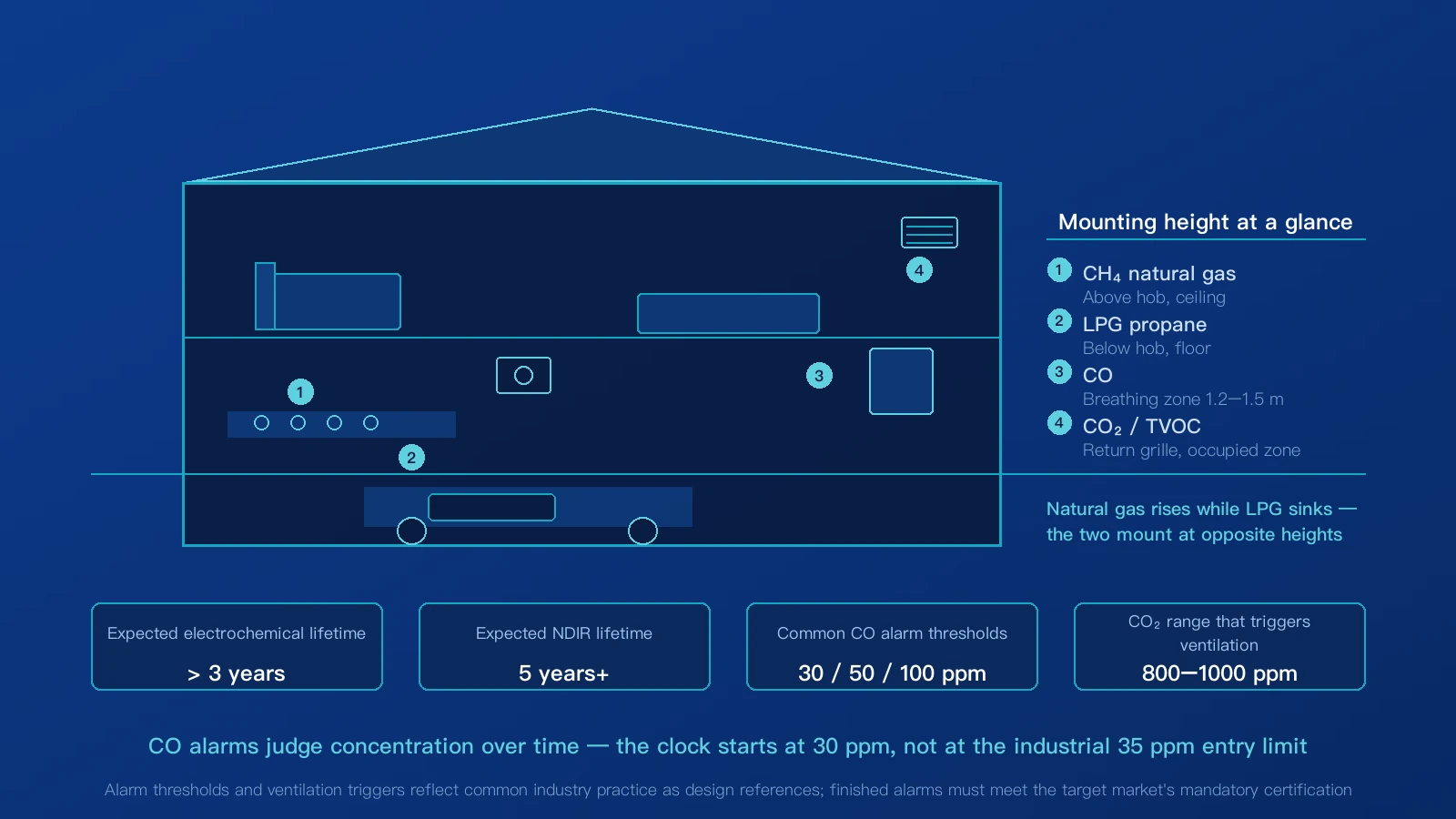
- > 3 years Expected electrochemical lifetime
- 5 years+ Expected NDIR lifetime
- 30 / 50 / 100 ppm Common CO alarm thresholds
- 800–1000 ppm CO₂ range that triggers ventilation
Alarms Want Maintenance-Free, Not Maximum Accuracy
Household alarms ship in volume, sit scattered in the field, and nobody is coming round with a calibration gas. What these products actually need is long-term zero stability, lot-to-lot consistency so the line needs no trimming, and cost — absolute accuracy ranks behind all three. Ask first whether the unit is still false-alarm-free six months out; that matters more than ±2% versus ±5%.
Combustible Alarms: Catalytic Beads Still Dominate, Infrared Takes the High End
Catalytic beads are cheap, fast and respond to most combustible gases, which is why they remain the mainstay of gas alarms; the trade-offs are susceptibility to poisoning, a need for oxygen and roughly a 5-year life. Infrared NDIR shrugs off cooking fumes and silicone vapour and lasts longer, making it the right choice for kitchens and underground car parks — at a higher unit price and with no hydrogen response. Semiconductor sensors are the cheapest option but drift heavily with temperature and humidity, so they appear mostly in low-end products outside mandatory certification.
CO Alarms: Electrochemical Is Effectively the Only Realistic Option
Household CO alarms are almost universally built on electrochemical CO sensors with a 0–1000 ppm range, 3–7 year expected life, and alarm thresholds defined by standards such as EN 50291 or GB 15322 as concentration-and-time combinations. One design point matters: the sensor usually outlives nothing — it expires before the appliance does — so either design for whole-unit replacement or make the cell serviceable.
Ventilation and IAQ: CO₂ for Control, VOC for Assessment
Ventilation systems modulate airflow on CO₂ — typically stepping up around 800–1000 ppm — because it tracks occupancy and human metabolism directly, while TVOC and formaldehyde drive air-quality scoring and purifier control. Don't substitute one for the other: high CO₂ does not mean high VOC, and high VOC does not mean you should simply increase outdoor-air intake.
Detection Points in Homes and Commercial Buildings
Ranges in residential and commercial products are much narrower than on industrial sites, and alarm points sit far lower — a household CO alarm starts its timer at 30 ppm, not at the 35 ppm entry limit.
| Gas | Typical Range | Recommended Principle | Duty Notes |
|---|---|---|---|
| Methane / natural gas | 0–100% LEL | Catalytic / NDIR | Kitchens and gas-meter locations; NDIR resists fume poisoning, and the long-life version suits commercial kitchens. |
| Propane / LPG | 0–100% LEL | Catalytic / low-power optical | Cylinders, restaurant kitchens and outdoor catering; heavier than air, so sense below burner level. |
| Carbon monoxide (CO) | 0–1000 ppm | Electrochemical | Water heaters, fireplaces and garages; alarms commonly step at 30 / 50 / 100 ppm. |
| Carbon dioxide (CO₂) | 0–2000 / 0–5000 ppm | NDIR infrared | Ventilation control and IAQ scoring; 800–1000 ppm is the usual ventilation trigger. |
| VOC / TVOC | 0–10 ppm | Electrochemical equivalent | Post-renovation air-quality scoring and purifier control — narrow range, resolution first. |
| Formaldehyde (HCHO) | 0–5 / 0–100 ppm | Electrochemical | Released from boards and furniture; the long low-level emission matters more than the peak. |
| Refrigerants R32 / R410A | 0–100% LFL | NDIR infrared | Commercial air-conditioning and cold-storage plant rooms; R32 is A2L mildly flammable and requires alarms by regulation. |
| Oxygen (O₂), supplementary | 0–25% vol | Electrochemical | Supplementary monitoring in poorly ventilated spaces such as underground garages and sealed plant rooms. |
CO alarm thresholds and ventilation triggers reflect common industry practice and are design references only; finished alarms must meet the mandatory standards and certification of the target market.
Models for Alarms and Appliances
Weighted towards lower ranges, with lot consistency and cost in mind. Bare cells suit high-volume lines with in-house boards; smart modules get you to a prototype faster.
11 gas categories covered
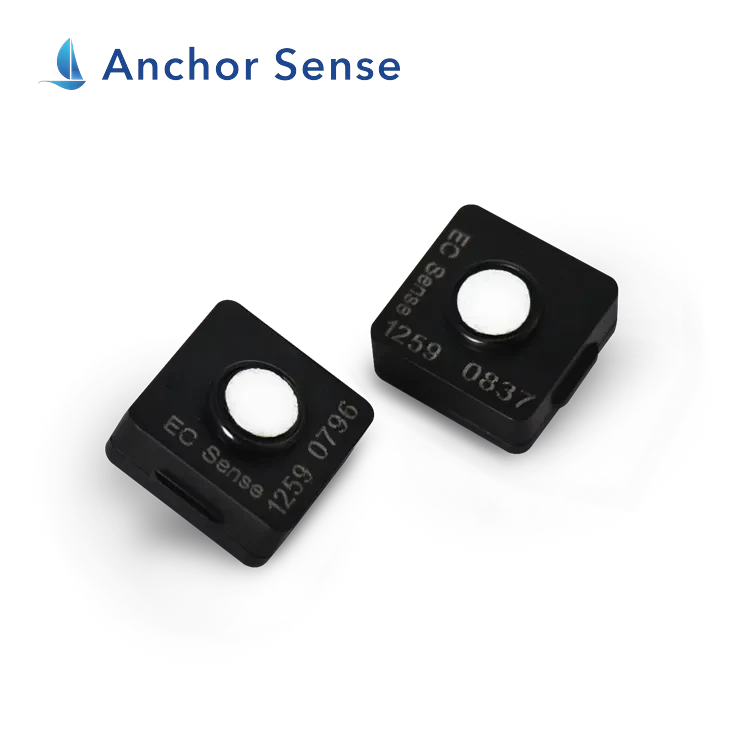
ES1-CO-1000 Carbon Monoxide Gas Sensor
Amperometric, 3-electrode
ES1 package, 0 – 1000 ppm range, Carbon Monoxide detection
View Details →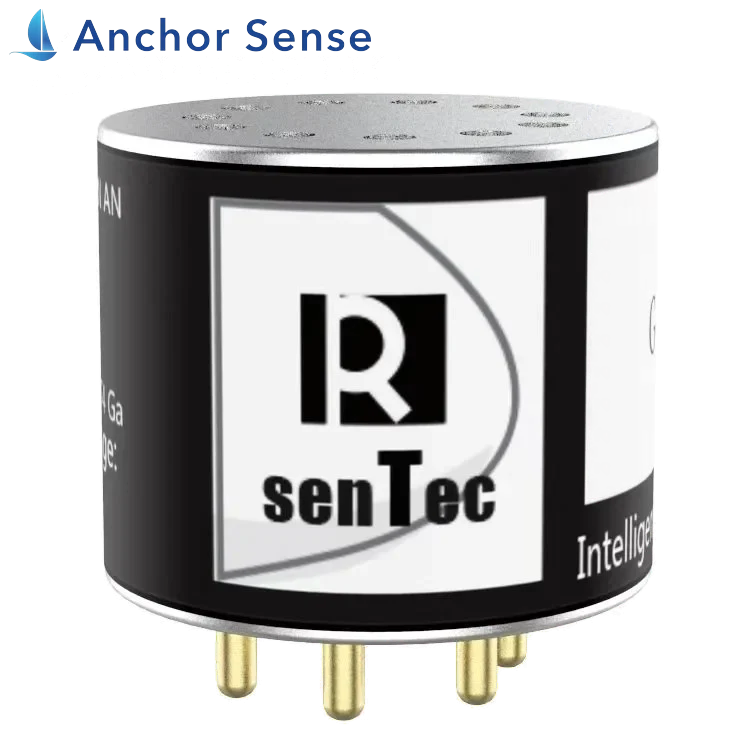
G4111 Methane NDIR Infrared Gas Sensor
Non-Dispersive Infrared (NDIR, dual-wavelength optical path)
Shanghai Yixin G4111, 0 – 100% LEL range, dual-wavelength NDIR detection
View Details →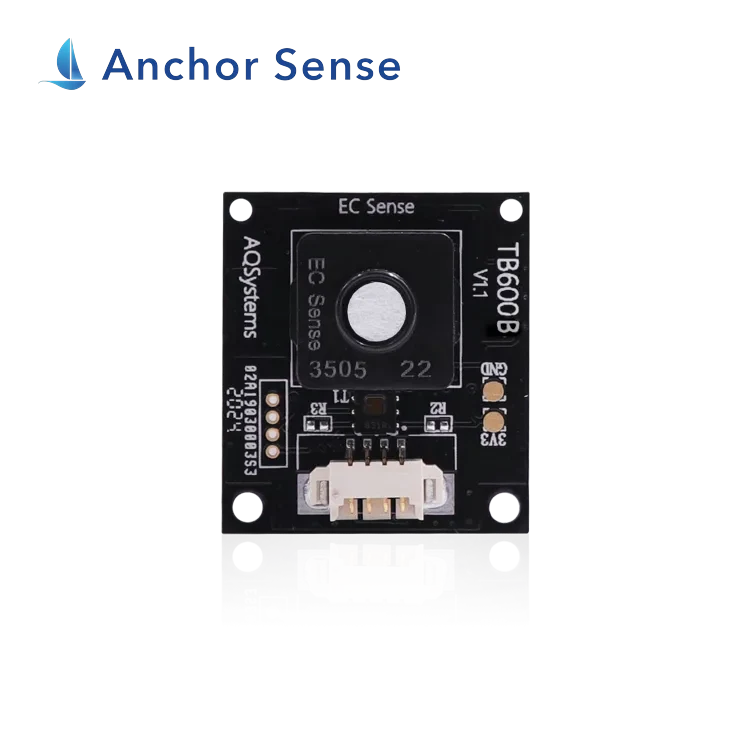
TB600B-IAQ-200 Indoor Air Quality (IAQ) Detection Module
Solid-Polymer Electrochemical (smart digital module)
0 – 200 ppm Indoor Air Quality (IAQ) smart digital detection module with UART / I²C output, built-in temp/RH sensing and factory calibration
View Details →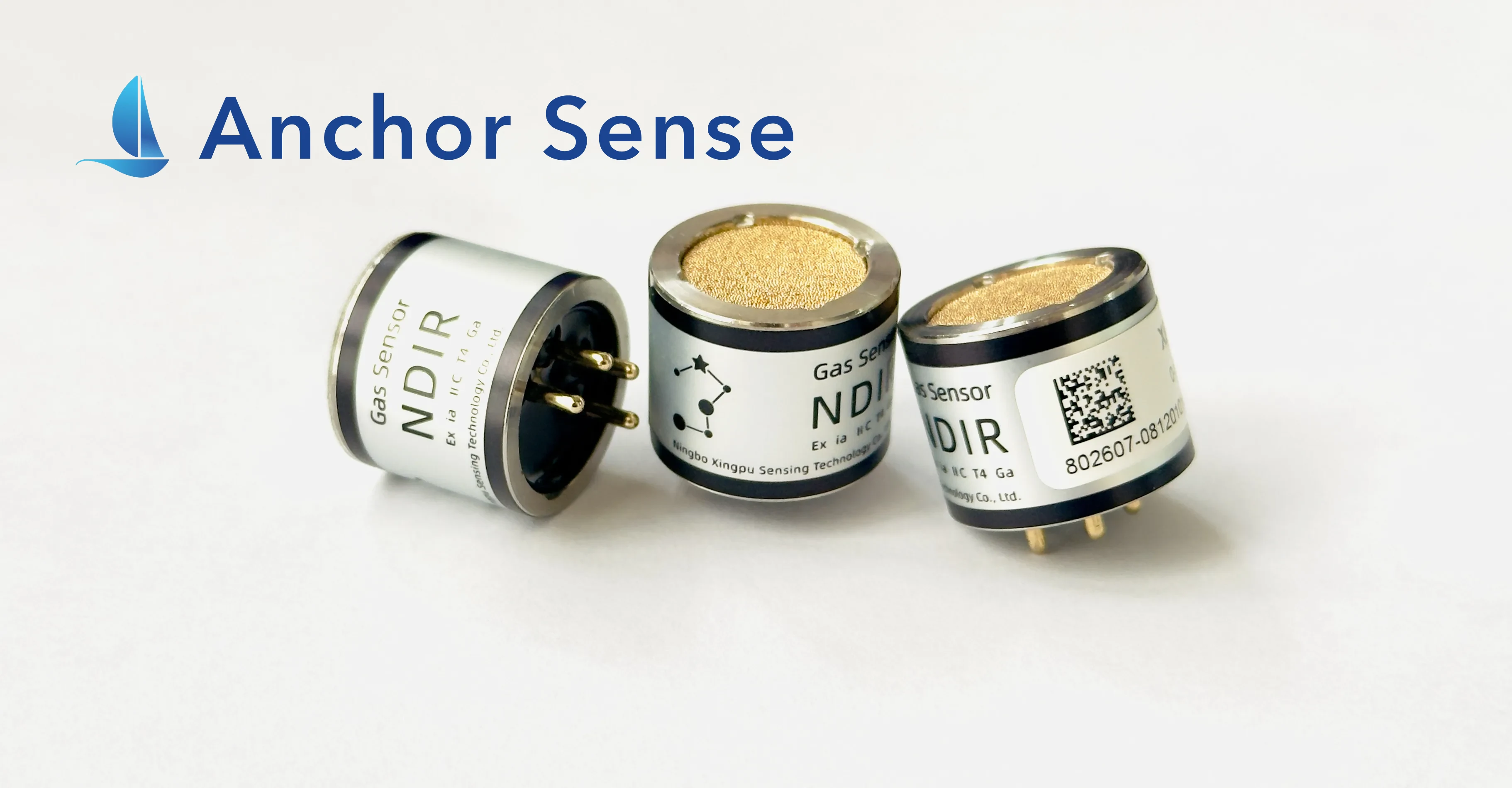
XPSN40A-R01L3 R32 NDIR Infrared Gas Sensor
Non-Dispersive Infrared (NDIR, low-power dual-wavelength optical path)
Ningbo Xingpu XPSN40A-R01L3, 0 – 100% LFL range, low-power NDIR infrared detection
View Details →Related Series
Frequently Asked Questions
What sensor goes into a household CO alarm?
Electrochemical CO sensors dominate, with a 0–1000 ppm range and 3–7 year life. Focus on long-term zero stability and lot consistency, because production lines usually do not calibrate unit by unit.
Can semiconductor sensors be used in alarms?
Technically yes, but they drift, react strongly to temperature and humidity, and need periodic recalibration — which is why they rarely appear in markets with mandatory certification and mostly show up in low-end or uncertified products.
Does the end user have to calibrate the sensor?
No. Household alarms are designed to be calibration-free; when the sensor reaches end of life the unit — or the cell module — is replaced, not calibrated on site.
Can you support appliance certification?
We supply the sensor, factory calibration data and lot-consistency reports; certification runs on your finished product. If you already have a certification list, we can propose a configuration from the models it permits.
Tell Us the Certification Target and Annual Volume
Target gas, certification target (CCCF / EN 50291 / UL 2034 and so on), intended appliance life, annual volume, and whether the board is in-house.
Contact us