
Application / Semiconductor & Electronics
Semiconductor & Electronics Gas Detection and Sensor Selection
In a fab the question is not whether an alarm exists but whether the reading can be trusted: phosphine and arsine are judged by toxicity, chlorine and fluorine by cross-sensitivity, SF₆ by its GWP.
- 0.3 ppm Phosphine TLV-TWA reference
- 0.05 ppm Arsine exposure limit — its odour threshold is 0.5–1 ppm
- 1,790 ppm Phosphine 10% LEL trip point (≈ 6,000× the limit)
- GWP 23,500 SF₆ 100-year warming potential (IPCC AR5)
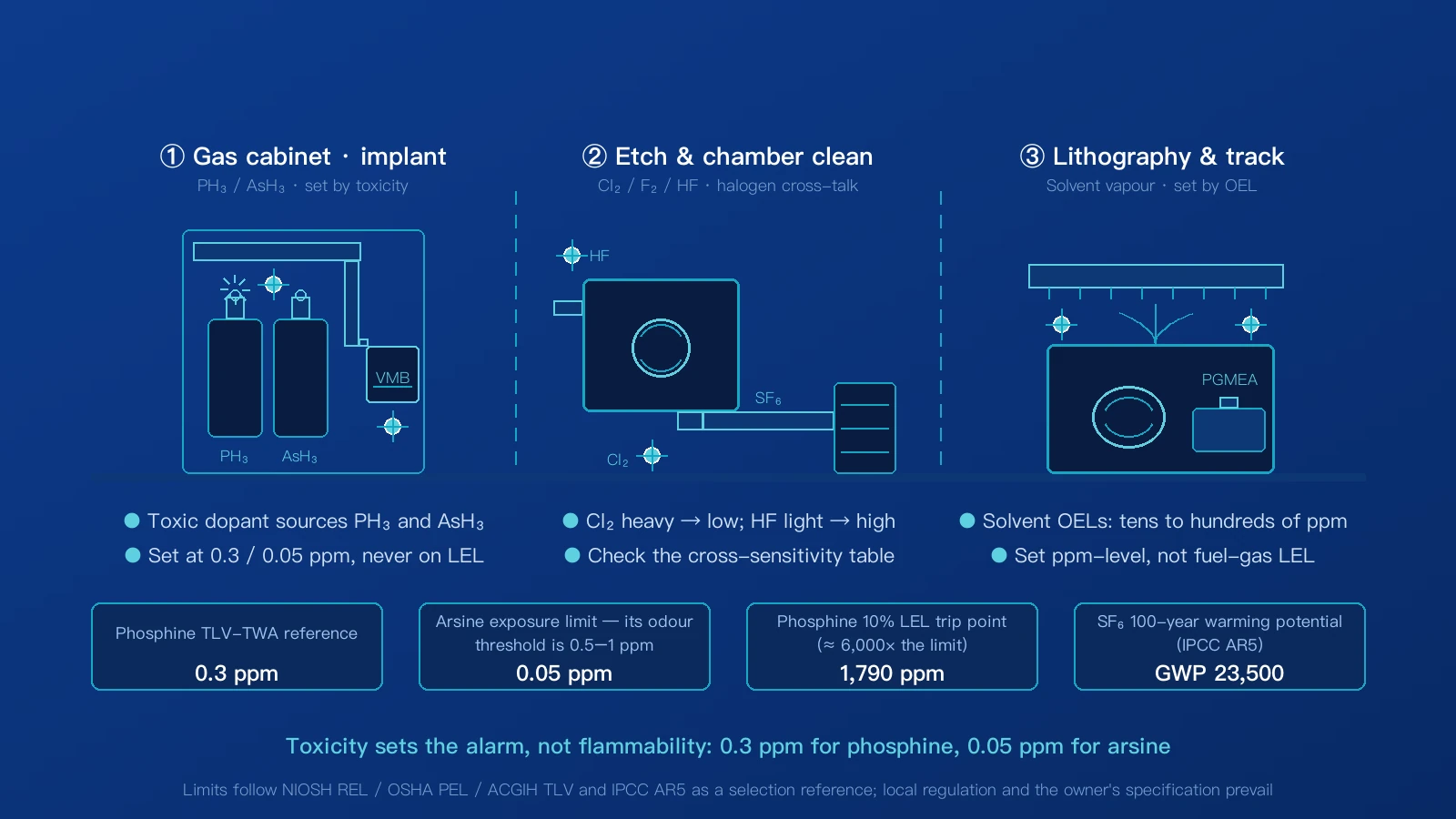
Gas Cabinets and Ion Implantation: Set by Toxicity, Ranged from the Limit
Phosphine (PH₃) and arsine (AsH₃) are the doping sources for ion implantation and diffusion, and the two gases in this industry that most demand toxicity-based set points. Phosphine has a TLV-TWA of 0.3 ppm and an IDLH of 50 ppm; arsine is harsher still — a 0.05 ppm exposure limit and a 3 ppm IDLH. Their lower explosive limits are absurdly high by comparison: 1.79% vol for phosphine and 5.1% vol for arsine, so a 10% LEL alarm waits for 1,790 ppm and 5,100 ppm — four to five orders of magnitude above the exposure limits.
These channels therefore have to be set by toxicity — phosphine in the 1 ppm region, arsine below 0.1 ppm — with points at the gas cabinet, the valve manifold box, the process exhaust and the scrubber outlet. Leaks happen at fittings, regulators and the moment a cylinder is changed, not in the middle of a straight pipe run.
Etch and Clean: Cross-Sensitivity Is the Real Selection Problem
Chlorine drives dry etching, fluorine and sulphur hexafluoride clean the chambers, and hydrogen fluoride and hydrogen chloride appear both in wet benches and as etch by-products in the exhaust. These gases usually share one area, which is exactly where electrochemical sensors are weakest: cross-response inside the halogen family is the norm, and a 0–10 ppm chlorine probe reads high in a fluorine-bearing atmosphere.
Two steps, both required: ask for the cross-sensitivity table and read what the sensor would report at the concentrations actually expected in that area, rather than only checking that the range fits; and fit an acid-gas filter to reject the interfering fraction. Even then, leave headroom in the set point commensurate with the interference. Setting it flush against the exposure limit turns interference into false leaks.
Sensors Are Consumables in a Fab: Discount the Life Rating
A fab sensor is not an instrument that runs for a decade — it is a consumable replaced every two to three years. Acid gases and halogens accelerate electrolyte consumption, silicon-bearing vapours poison catalytic elements, and continuous low-level exposure in a cleanroom wears the cell down just the same. What decides whether the system survives three years is therefore not the last decimal place of accuracy but three things: factory pre-calibration (there is nowhere on site to calibrate), a single digital output (a probe swap changes no wiring and no host program), and single-person plug-in replacement.
The DS4 and TB600B&C families in this catalogue take exactly that route: factory pre-calibration, UART / I²C digital output, and measurement from power-up (DS4 stabilises in under 2 minutes with no warm-up) at 0.65 mA on 5 V. Low power here is not just about saving electricity — cabling to gas cabinets and remote valve boxes regularly costs more than the sensors do, and milliamp draw is what makes battery-powered wireless nodes genuinely usable.
Lithography and Track: Why Solvent Vapours Are Judged in ppm, Not LEL
The solvents in lithography and track areas — PGMEA, isopropanol, acetone, cyclohexanone — and the TMAH developer all evaporate continuously at room temperature. The usual misconfiguration here is to copy the fuel-gas template and alarm on LEL: most organic solvents carry occupational limits in the tens to hundreds of ppm, while a 10% LEL trip point often sits in the thousands — the same "over the toxic limit long before the alarm" problem again.
The right answer is a ppm-level criterion (the 0–200 ppm range) for solvent areas, and the LEL criterion only where explosion protection is genuinely the driver. By principle, prefer electrochemical VOC: roughly a third of the cost and a fraction of the bulk of a PID, with no UV lamp and no scheduled cleaning. Reserve PID for cases that must resolve individual components or reach several thousand ppm.
Gases to Monitor in Semiconductor Manufacturing
From the gas cabinet to the lithography bay, one line carries three orders of magnitude: the toxic hydrides used for doping reach below 1 ppm, the halogen clean and etch gases sit at ppm level, and SF₆ is accounted for as a greenhouse gas in its own right.
| Gas | Typical Range | Recommended Principle | Duty Notes |
|---|---|---|---|
| Phosphine (PH₃) | 0–20 / 0–2000 ppm | Electrochemical (smart digital output) | Dopant source for ion implantation and diffusion; TLV-TWA 0.3 ppm, so set points follow toxicity. At a relative density of 1.18 it is close to air — inside a cabinet rely on diffusion and the exhaust duct. |
| Arsine (AsH₃) | 0–1 ppm | Electrochemical (smart digital module) | The other dopant source in the same steps; a 0.05 ppm exposure limit against a 0.5–1 ppm odour threshold — only an instrument will do. Choose a 1 ppm full scale with sub-0.02 ppm resolution. |
| Chlorine (Cl₂) | 0–10 / 0–50 ppm | Electrochemical (smart digital output) | The workhorse of dry etching; heavier than air, so sense low and in trenches. Halogen cross-sensitivity is universal here — always ask for the cross-sensitivity table. |
| Fluorine (F₂) | 0–5 ppm | Electrochemical | Chamber-clean gas, heavier than air, so sense low; where it shares an area with chlorine, assess cross-response and fit an acid-gas filter if needed. |
| Hydrogen fluoride (HF) | 0–10 ppm | Electrochemical | Wet benches and etch by-product; lighter than air (relative density about 0.7), so sense high — the opposite of chlorine. Aggressively corrosive to glass and to tissue. |
| Sulphur hexafluoride (SF₆) | 0–1000 ppm (extendable to 2000 / 3000) | NDIR infrared | Etch and chamber-clean gas; a 100-year warming potential of 23,500 (IPCC AR5), the highest of any gas in routine industrial use, so abatement ledgers must account for it as a separate line. |
| Ammonia (NH₃) | 0–100 ppm | Electrochemical (smart digital output) | Precursor for silicon nitride CVD; lighter than air, so sense high. Set alarms on toxicity, not flammability. |
| Hydrogen (H₂) | 0–1000 ppm / 0–5% vol | Electrochemical | Carrier gas for epitaxy, annealing and reducing atmospheres; LEL 4% vol, one of the few flammability-driven channels on this page. Extremely light, so sense at the ceiling and high points. |
| Total VOC (TVOC) | 0–200 ppm | Electrochemical (smart digital output) | PGMEA, isopropanol, acetone and similar solvents in lithography and track areas; use a ppm-level criterion against the OEL rather than the fuel-gas LEL template. |
Limits follow NIOSH REL / OSHA PEL / ACGIH TLV and IPCC AR5 global warming potentials, as a selection reference only. This page does not replace a fab's gas detection system design: set points, interlock logic and point counts must follow the gas list, tool layout, exhaust design and local regulation.
Recommended Models for Semiconductor Manufacturing
ppm-level channels across gas cabinets, ion implantation, etch and clean, thin-film deposition, lithography solvents and scrubber outlets — on one digital output scheme, so a probe swap changes no wiring and spares and calibration collapse into a single set.
14 gas categories covered
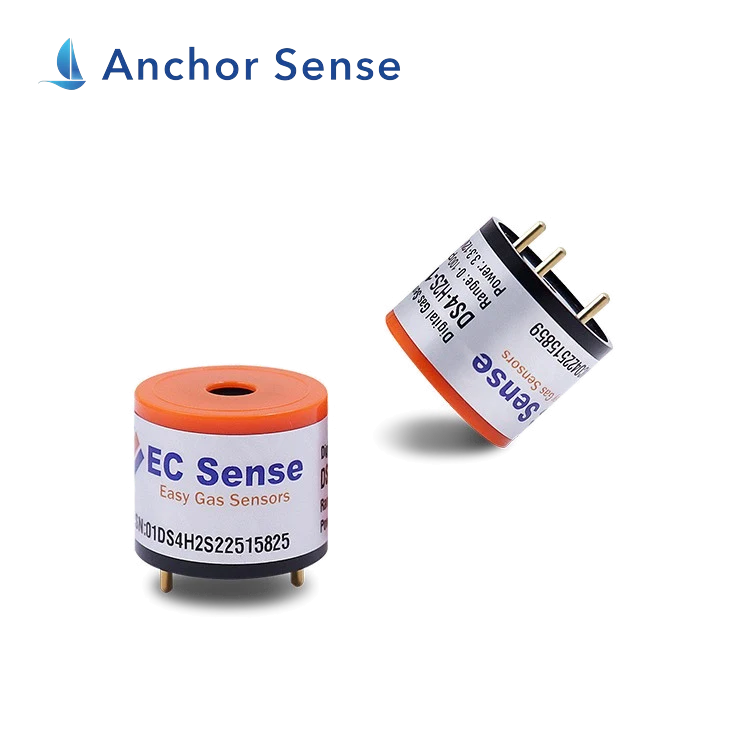
DS4-PH3-20 Smart Phosphine Gas Sensor
Printed Solid-Polymer Electrochemical (smart digital output)
EC Sense DS4 smart Phosphine sensor, 0 – 20 ppm range, 0.1 ppm resolution, UART digital output, factory-calibrated
View Details →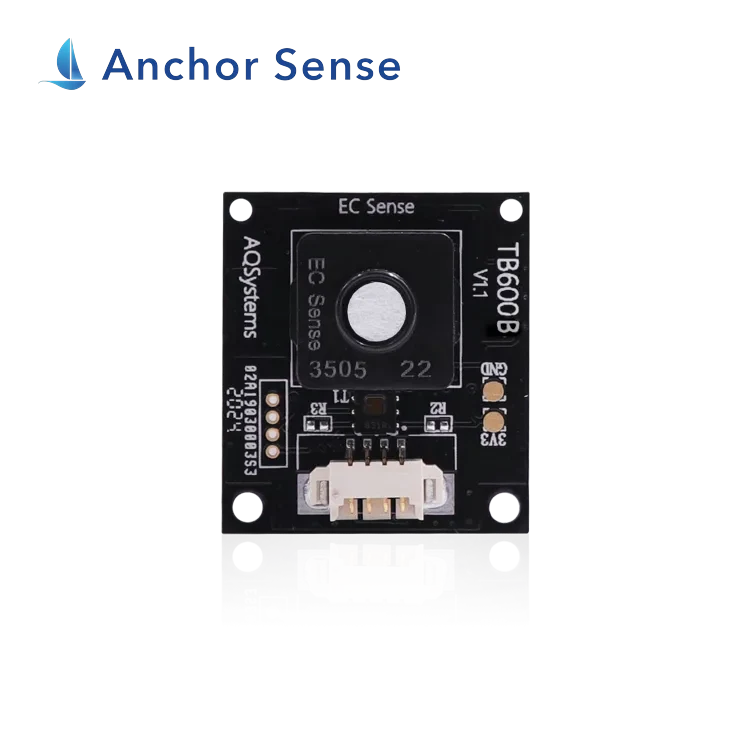
TB600B-AsH3-1 Arsine Detection Module
Solid-Polymer Electrochemical (smart digital module)
0 – 1 ppm Arsine smart digital detection module with UART / I²C output, built-in temp/RH sensing and factory calibration
View Details → DS4-Cl2-10 Smart Chlorine Gas Sensor
Printed Solid-Polymer Electrochemical (smart digital output)
EC Sense DS4 smart Chlorine sensor, 0 – 10 ppm range, 0.01 ppm resolution, UART digital output, factory-calibrated
View Details →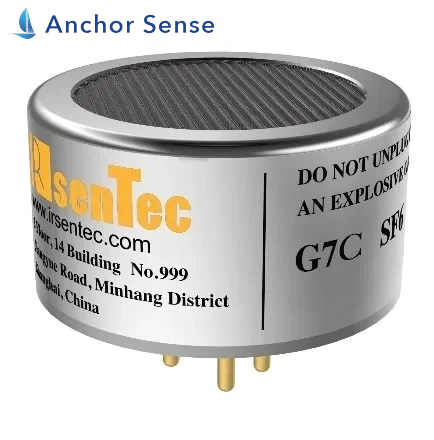
G7-SF6 Sulfur Hexafluoride NDIR Infrared Gas Sensor
Non-Dispersive Infrared (NDIR)
Purpose-built for SF6 leak detection: 0-1000 ppm (extendable to 2000/3000 ppm), ≤±2%FS
View Details → DS4-TVOC-200 Smart TVOC Gas Sensor
Printed Solid-Polymer Electrochemical (smart digital output)
EC Sense DS4 smart TVOC sensor, 0 – 200 ppm range, 0.1 ppm resolution, UART digital output, factory-calibrated
View Details →Related Series
Frequently Asked Questions
Both doping gases are flammable — why not set alarms on flammability?
Because setting it on flammability means never alarming at all. Phosphine's LEL is 1.79% vol, so 10% LEL is 1,790 ppm against a TLV-TWA of 0.3 ppm — roughly six thousand times higher; arsine is worse, with a 5.1% LEL making 10% LEL 5,100 ppm against a 0.05 ppm limit. By the time a flammability alarm sounds, the exposure is already irreversible. Both channels must be set on toxicity, with flammability as a redundant reference at most.
Why insist on a 0–1 ppm full scale for arsine?
Because the exposure limit sits at 0.05 ppm while the odour threshold is 0.5–1 ppm — the nose only reacts ten times over the limit, so it cannot be a backstop. A 1 ppm full scale with sub-0.02 ppm resolution is what allows a change to be resolved near the limit; a 0–100 ppm range is meaningless for arsine, reading flat at zero with no visible drift and no reachable alarm.
With chlorine and fluorine in the same area, will the sensors interfere?
Yes. Cross-response within the halogen family is universal in electrochemical sensors, and a chlorine probe reads high in a fluorine-bearing atmosphere. Two things are needed: obtain the cross-sensitivity table and read what the sensor reports at the concentrations actually expected; and fit an acid-gas filter to reject the interfering fraction. Even then, leave set-point headroom commensurate with the interference rather than sitting flush against the exposure limit.
Do you carry sensors for silane (SiH₄) or diborane?
Yes — but these three sit on the ES1 / ES4 sensor and TB420 transmitter line, not on the DS4 series shown on this page: silane in 0–10 ppm and 0–50 ppm versions, diborane at 0–1 ppm (0.001 ppm resolution) and germane at 0–5 ppm, all matched and quoted per project. Send the gas, the range and the mounting format. ⚠️ One prerequisite to settle before sizing: the silane sensor carries roughly 20% positive cross-response to hydrogen (100 ppm H₂ reads as about 20 ppm silane), and a-Si:H / µc-Si PECVD and silane furnace processes use hydrogen heavily, so readings near the same chamber are lifted systematically — where H₂ coexists at the point, subtract in the system or raise the alarm threshold accordingly and record it. Cl₂ is a negative interferent on that channel. Nitrogen trifluoride (NF₃) we do not currently have a dedicated sensor for.
Why does SF₆ deserve its own detection channel?
Two reasons. For safety it is an etch and chamber-clean gas whose leaks concentrate at the cabinet and pipe fittings; for compliance its 100-year warming potential is 23,500 (IPCC AR5), the highest of any gas in routine industrial use — far above NF₃ at 16,100 and CF₄ at 6,630 — so semiconductor and power-sector abatement ledgers require per-gas accounting and monitoring, never one summed mass with an average GWP applied.
Send Us the Gas List and the Process Zoning
The gas list and what each is used for (doping, etch, clean, deposition, solvent), the process zoning and tool layout, point locations (cabinet, valve box, exhaust duct, scrubber outlet, room), whether GDS interlock is required, and power and communications.
Contact us